
Play Longer, Hurt Less: Rethinking Guitar Ergonomics
You pick up your guitar feeling great. An hour later, your shoulder feels tight. Your neck is stiff. Maybe your lower back is starting to complain.
For a lot of guitarists, those little aches are so familiar that we barely question them. We stretch, shake out our hands, shift the strap and keep playing.
But playing guitar is a physical activity. And just like any other physical activity, the way we move—and the equipment we’re using—can affect how our bodies feel.
The question isn’t simply, “Do I have good posture?”
A better question might be: “How hard is my body working to play this guitar?”
Guitar Is an Asymmetrical Activity
Think about what happens when you play.
One arm reaches around or over the body of the guitar. The other extends along the neck. Your head may turn toward the fretboard. If you’re standing, the instrument hangs from a strap across one shoulder. If you’re sitting, you may shift your hips or torso to keep the guitar in position.
None of these movements is inherently bad. The problem can come when we hold them for long periods or add unnecessary muscular tension.
And guitarists are particularly good at developing habits without realizing it.
Maybe you lean forward every time you look at the fretboard. Maybe your shoulders gradually creep toward your ears during a difficult passage. Maybe you grip the neck harder when you’re concentrating. Or perhaps you twist your torso slightly to compensate for where the guitar naturally wants to sit.
Do something for five seconds and it may not matter much. Do it for two hours of rehearsal, night after night, and you may start to notice it.
There May Not Be One “Perfect” Posture
One useful way of thinking about this comes from the Alexander Technique, an educational approach to movement and body awareness that has long been used by musicians, actors and other performers.
Rather than teaching people to lock themselves into a single “correct” posture, the Alexander Technique emphasizes becoming aware of habitual tension and learning to move with less unnecessary effort.
That’s an important distinction for guitar players.
Good posture doesn’t necessarily mean sitting perfectly straight or forcing your shoulders into a particular position. In fact, trying too hard to maintain a rigid posture can create tension of its own.
Instead, think about dynamic balance: allowing your head, neck, shoulders, back and arms to move freely rather than holding yourself in one fixed position. In other words, don’t turn posture into another thing you have to tense up to get right.
Watch What Happens When You Look at the Fretboard
Here’s a simple experiment.
Pick up your guitar and play something you know well. Then notice what happens when you look down at your fretting hand.
Did your head move forward?
Did your shoulders round?
Did your upper body follow your eyes toward the guitar?
Now look straight ahead and play the same passage again.
The goal isn’t to never look at the fretboard. It’s simply to become aware of how much of your body moves when you do. Small habits like this can accumulate over a long practice session.
Your Hands May Be Working Harder Than They Need To
Tension isn’t limited to posture. Pay attention to how hard you’re pressing the strings. Many players use more fretting pressure than they actually need, particularly when a passage becomes difficult.
Try playing a note and gradually reducing the pressure of your fretting finger until the note begins to buzz. Then add just enough pressure to make it ring cleanly again. You may be surprised by how little force is actually required.
The same idea applies throughout the body. Check your picking hand. Your jaw. Your shoulders. Even your toes. Musicians can recruit an impressive number of completely unnecessary muscles when they’re concentrating.
And Then There’s the Guitar Itself
We spend a lot of time talking about what players can do differently. But there’s another part of the equation that gets much less attention:
The instrument.
A guitarist can become more aware of posture and tension, but the physical characteristics of the guitar still determine what the player’s body has to accommodate.
Weight is perhaps the most obvious example.
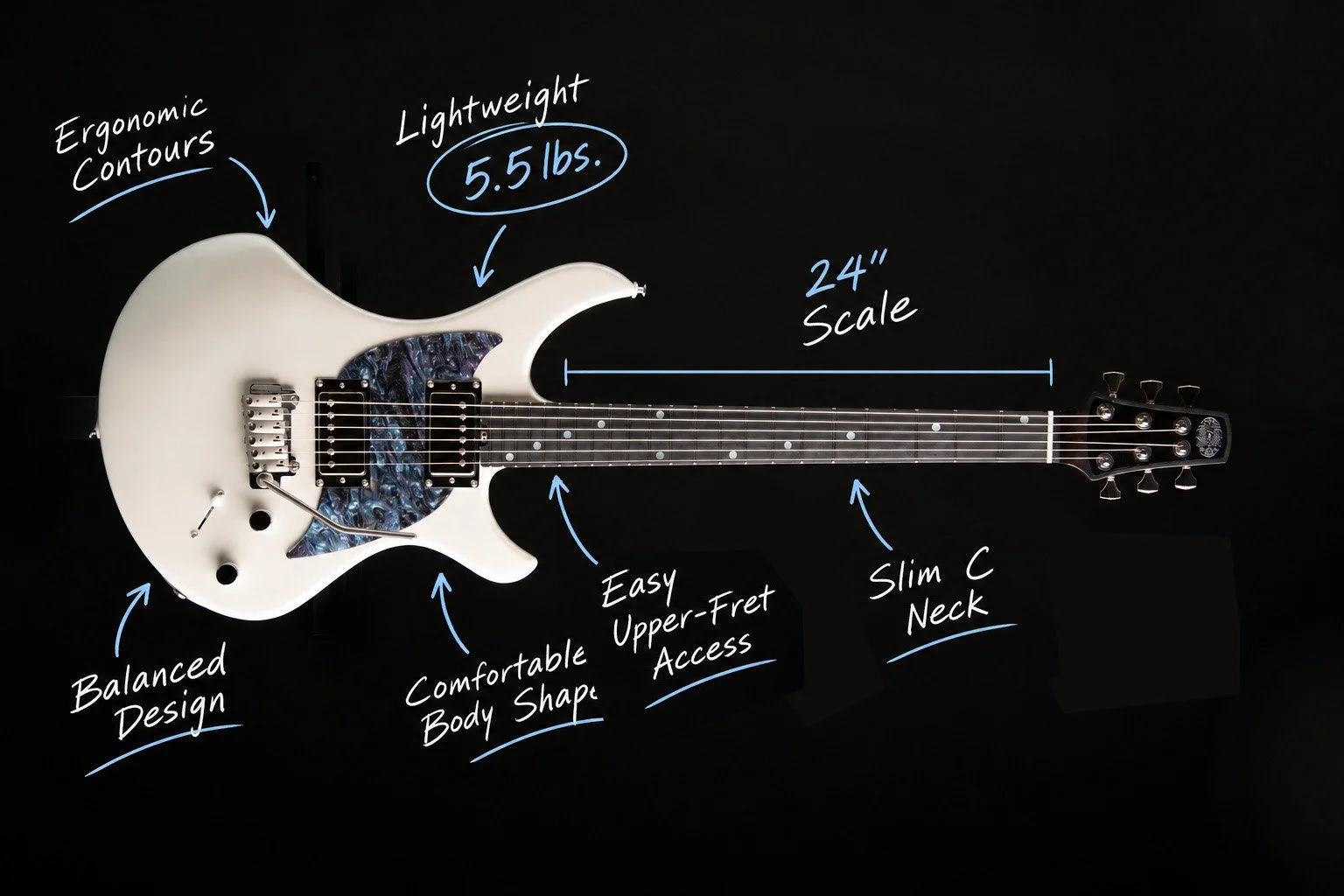
A traditional solidbody electric can easily weigh 8 pounds or more. Hang that weight from your shoulder through a rehearsal, a gig or an afternoon of practice and you’re carrying a substantial load for a long period of time.
A lighter guitar doesn’t automatically solve back, neck or shoulder problems, nor should it be considered a treatment for pain or injury. But reducing the amount of weight you’re carrying is one straightforward way to reduce the physical load involved in playing. And weight is only part of ergonomics.
Fit Matters, Too
Consider all the places where you and your guitar interact.
How far does your fretting arm have to reach?
Where does the body sit against your torso?
Does the guitar feel balanced when you’re standing?
How high do you need to raise your shoulder or elbow?
How easily can you reach the upper frets?
How much tension do the strings require for the bends and vibrato you like to play?
Scale length, neck profile, body shape, contours, weight and balance can all influence the experience. This is why two guitars can feel dramatically different even when they look fairly similar on a spec sheet. Your body notices.
Try a Five-Minute Guitar Ergonomics Check
The next time you practice, spend a few minutes paying attention to your body rather than your playing.
Notice your head and neck. Are you repeatedly craning toward the fretboard? Let your shoulders relax. See if they gradually rise again as you play.
Experiment with your strap height. Moving the guitar even slightly may change the position of your wrists, shoulders and neck.
Notice how hard you’re fretting. Try using less pressure.
If you’ve been sitting, stand for a while. If you’ve been standing, take the guitar off and move around.
Most importantly, notice where the guitar naturally wants to sit—and where you’re moving your body to accommodate it. You don’t have to overhaul your technique. Awareness alone can reveal a lot.
Maybe the Guitar Should Meet You Halfway
For much of electric guitar history, players have adapted themselves to instruments whose fundamental dimensions and designs were established generations ago.
At Venus, we started with a different premise. What if we considered the player’s body first?
That’s why the Venus Revolution weighs approximately 5.5 pounds and uses a 24-inch scale, a slim C-profile neck, ergonomic body contours and a design intended to feel balanced and comfortable whether you’re sitting or standing.
These aren’t features designed to tell you how you should play. They’re intended to give your body less to fight against while you do.
Because becoming a better player shouldn’t necessarily mean learning to tolerate discomfort. It can also mean becoming more aware of how you’re using your body—and choosing an instrument that works with you rather than asking you to work around it.
Designed around the player—not tradition.